Search This Blog

Friday, February 19, 2016

Forms and Formulas for Lines

Let's talk about lines. In this post, I will talk about the various forms and formulas of lines. We will start with the slope formula.

We know with a line that a slope is constant. Its steepness is always the same.


This is the point-slope form. What if I take point-slope form, and plug in (0,b) , y-intercept, as the point.
Look, I got slope-intercept form.

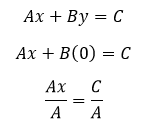
Now, let's look at standard form:

Let's find the following
a. x-intercept (#,0)
b. y-intercept (0,#)
c. slope

a. x-intercept


For parts a and b, I can find the slope and y-intercept by solving for y, simplifying, and then comparing it to slope-intercept form.

Note on Forms and Formulas

The main difference between the two is a form describes all the points on the line. It describes the set of all points falling on the line. Whereas a formula results in a specified value given other values.

The slope formula is used to find the slope given two points. On the other hand, whether it is point-slope form, slope-intercept form, or standard form, it describes every point on the line. This is why the variables x and y are used. The form is true for every point (x,y) that satisfies the equation. (x,y) is varying on the line as the slope and a point are staying constant.

Review

For more on lines, check out my YouTube Videos.

Thursday, January 28, 2016

Can a variance be negative?

Let's talk about a variance being negative. The other day I worked out a discrete probability distribution problem, and I got a negative variance. The variance is always positive. It would be zero if the data was all the same value. It should never be negative. 


In this post, I will show how I first did the problem. Then I’ll show why that the negative answer is incorrect, and how it happened.

Problem

Calls for a crisis hotline. The number of calls received per day at a crisis hotline is distributed as follows:
Number X
30
31
32
33
34
Probability P(x)
0.05
0.21
0.38
0.25
0.11

Find the mean, variance, and the standard deviation of the distribution.
(Problem #18 pg. 307 from Bluman, A. (2013). Elementary statistics (9th ed). New York, NY: McGraw-Hill)

Part 1: The work at first glance

Finding the mean


The mean is 32.2 using the rounding rule. This is correct.

Finding the variance

Obviously, you can’t get a negative variance, so I tried the exact mean, 32.16.


1.1 is the correct variance using the rounding rules.

Part 2: Finding the Error

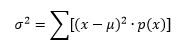
The work is correct. It should not matter if you plug in the rounded or exact mean. The variance should still be positive. The issue comes up with the shortcut formula. When the regular formula is used for variance, it results in variance close to 1.0744 using the rounded mean, 32.2.
Note: the differences are always being squared resulting in either a zero or positive value. They are never negative. Because of this, variance is always positive. It should not matter if 32.16 or 32.2, but it does.


Using the regular formula with the rounded mean, it is pretty close to the variance using the exact mean. Here is the regular formula for variance using the exact mean:


It is the same as the shortcut formula as it should be. Notice with using the exact mean or the rounded mean, you still get 1.1 for your variance when using the rounding rules. But why is it when you use the rounded mean for the shortcut and regular formula you get two different answers with one being negative.

It is important here to look at how the shortcut formula is derived from the regular formula. Note that µ is a constant in the formula. 


The problem arises with the substitution. In order to make the substitution and combine like-terms, you are assuming that all µ’s are the same. If you use the rounded mean, the µ’s are not all the same. You will have unlike terms, so you will not able to combine them to simplify.


Notice the solution is the same one we found using the regular formula.

Conclusion

When you using the shortcut formula for calculating the variance for a discrete probability distribution, you have to be careful when you plug in a rounded mean. It is better to use the exact mean if possible, or to use a rounded mean closer to the exact. The question arises from this, “Does this happen with other shortcut formulas found in statistics?”

In case, if you worrying how to get the standard deviation, you just need to take the square root of the variance. By the way, variance should always be positive or equal to zero.

Friday, January 15, 2016

Formulas for Quadratic Functions

Let's talk about the quadratic function or parabolas. We will first look at a quadratic function in vertex form, and then we will look at a quadratic function in standard form. We find vertex and intercept formulas for both.

Here is a parabola in vertex form:

(h,k) would be your vertex. The intercepts can setting either x or the y to zero. So to find the y-intercept, you set the x equal to 0.

So the y-intercept is (0, ah^2+k). To find the x-intercept, you set y equal to 0.

This is an interesting formula, because if your a and k are the same sign, you'll end with two complex but not real roots.

Now, let's look at a parabola in standard form.

It does not give you the vertex right away.  If I use a little calculus, take the first derivative with respect to x, and set equal to 0, I will get the minimum or the maximum, which is the vertex. 


So 


Now, let's find k. To find k (the y-coordinate of the vertex), we would just have to plug what h is (x-coordinate) into the function.


We found the vertex for standard. Let's find formulas for the intercepts.

For the y-intercept,


y-intercept is (0,c). The formula for the x-intercepts I found in a previous post (http://mathtalkwithjd.blogspot.com/2015/09/deriving-quadratic-formula.html).
It's the quadratic formula.


If I wanted to, I could make D=b^2-4ac. It would simplify the formulas for standard form, but first let's review the formulas we found for vertex form.

Formulas for Vertex Form of a Parabola

Formulas for Standard Form of a Parabola


Hopefully, you have found this helpful. Please e-mail me if you have questions. Let's talk math.

Wednesday, December 9, 2015

Unit Circle: Patterns

In this post, I will show the patterns of values found in the unit circle. I will first derive the values of two triangles, show a pattern of the values, and show a pattern of the signs.

When it comes to trigonometry, knowing the unit circle is key. I think these three things will be very helpful.

Part 1: Derive the values of two triangles

The triangles that are part of unit circle are 45-45-90 triangle and 30-60-90 triangle. These two triangles are what make up all the values on the unit circle except the points on the axis's (i.e. 0, 90, 180, 270, 360). Let's derive the values from these two triangles.

45-45-90 Triangle

Since it is an isosceles, I write with the legs equaling to x and the hypotenuse equal to 1 (see figure 1).
Figure 1. 45-45-90 Triangle.


30-60-90 Triangle

With the 30-60-90 triangle, I can take two of these triangles and for an equilateral triangle (see figure 2).
Figure 2. Equilateral triangle with two 30-60-90 triangles


Now I can find the remaining side of the 30-60-90 triangle.


Part 2: Values that appear in the unit circle.


Let's use equivalent values to show a pattern.
On a calculator, the values look like this:

Part 3: Sign rule of the unit circle

The unit circle is formed by a right triangle (see figure 3). The angle of focus is formed by the horizontal side and the hypotenuse of the right triangle.

Figure 3. Right triangle in Unit Circle

The trigonometric functions can be formed using the coordinates.

This means that the signs of the ratios are based the location of the point on the unit circle. In other words, it depends which quadrant the point is in. Now consider the signs in each quadrant. In quadrant I, the points (x,y) are (+,+). This means all trigonometric functions are positive in quadrant I. In quadrant II, the points are (-,+). So, sine function is positive because the y’s are positive, but the other functions are negative. In quadrant III, the points are (-,-), so the tangent function would be positive, but the sine and cosine function would result in a negative. In the quadrant IV, the points are (+,-). Cosine function would be positive, but the others would be negative.

An easy way to remember the signs rules is with the acronym, A Smart Trig Class. It is an order of the quadrants.
Figure 4. A Smart Trig Class with Quadrants

It signifies which values are positive. In the first quadrant, the values of ALL trigonometric functions are positive. In the second quadrant, the values of the SINE function are positive and the others are negative. In the third quadrant, the values of the TANGENT function are positive and the others are negative. In the fourth quadrant, the values of the COSINE function are positive and the others are negative.

Hopefully, these patterns are helpful for the unit circle. I think the patterns are useful, because it makes the memory work easier. And if you forget, you can always use the patterns to make your own unit circle.  

Determining Odd or Even Functions

Let's talk functions. In this post, I show how to determine if a function is odd or even.

The function is odd ↔ f(-x)=-f(x)

The function is even ↔ f(-x)=f(x)

Is It an Even or Odd Function?

If you have questions, please e-mail me at jdmathguy@gmail.com.

Factoring Trinomials: Factor Grid Method

Let's talk about factoring trinomials. This method is exhaustive.

Procedure
Ax2+Bx+C

Step 1: List out factors of A and C. Factors of A form the rows and factors of C form the columns.

Step 2:  Setup the grid. Multiply the column by the row and put result in the corresponding square. It forms major squares and minor squares.

Step 3:  Look at the diagonals of each major square.
  •  If C is positive, then find the sum resulting in B. (Outer + Inner)
  •   If C is negative, then find the difference resulting in B. (Outer-inner or inner-outer)

Step 4: Setup the factors by using the grid.
  • First, label the diagonal of the major square with inner and outer.
  •  Second, label the row term (FI – first inner) and column term (LI- last inner) that line up with the “inner” term of the diagonal.
  • Third, label the row term (FI – first outer) and column term (LI- last outer) that line up with the “outer” term of the diagonal.
  • Fourth, using (FO_LI)(FI_LO) setup the factors.

Step 5: Choose the signs.

Mechanics
Binomial times a binomial. It involves a method called FOILing.
(A+B)(C+D)
AC+AD+BC+DB
First+Outer+Inner+Last

On the grid:
First/Last
B
D
A

AD=Outer
C
BC=Inner


Therefore, one can set up their factors this way.
First/Last
B - LI
D - LO
A –FO

AD=Outer
C – FI
BC=Inner

(By simply seeing how they align. C is part of both the first term and inner term, A is part of both the outer term and the first term, etc.)
(FO+LI)(FI+LO)

The other diagonal produces another possible:
(C+B)(A+D)
AC+CD+BA+DB
First+Outer+Inner+Last

On the grid
First/Last
B
D
A
BA=Inner

C

CD=Outer

First/Last
B - LI
D - LO
A –FI
BA=Inner

C –FO

CD=Outer

(By simply seeing how they align. A is part of both the first term and inner term, C is part of both the outer term and the first term, etc.)
(FO+LI)(FI+LO)
Notice on the grids. One grid can contain two possible combinations of the outer and inner while the first and the last remain the same.

Examples
1. x2+5x+6

Step 1: List out factors of A and C
A=1
1x*1x
C=6
3*2, 6*1

Step 2: Setup the grid
First/Last
2
3
6
1
1x
2x
3x
6x
1x
1x
2x
3x
6x
1x

Step 3: Look at the diagonals of each major square.
First/Last
2
3
6
1
1x
2x
3x
6x
1x
1x
2x
3x
6x
1x

Step 4:
First/Last
2 -LO
3 - LI
6
1
1x - FO
2x - outer
3x
6x
1x
1x - FI
2x
3x -inner
6x
1x
Using (FO+LI)(FI+LO), you get (x_3)(x_2)

Step 5:
(x+3)(x+2)

2. 3x2-2x-16

Step 1:
A=3
3x*1x
C=16
1*16, 2*8, 4*4

Step 2: Setup the grid
First/Last
1
16
2
8
4
4
3x
3x
48x
6x
24x
12x
12x
1x
1x
16x
2x
8x
4x
4x

Step 3: Look at the diagonals of each major square.
First/Last
1
16
2
8
4
4
3x
3x
48x
6x
24x
12x
12x
1x
1x
16x
2x
8x
4x
4x

Step 4:
First/Last
1
16
2 - LI
8 - LO
4
4
3x – FI
3x
48x
6x – inner
24x
12x
12x
1x - FO
1x
16x
2x
8x – outer
4x
4x
Using (FO+LI)(FI+LO), you get (x_2)(3x_8)

Step 5:
(x+2)(3x-8)

3. 8x2+114x+81

Step 1:
A=8
8x*1x, 4x*2x
C=81
1*81, 3*27, 9*9

Step 2: Setup the grid
First/last
1
81
3
27
9
9
8x
8x
648x
24x
216x
72x
72x
1x
1x
81x
3x
27x
9x
9x
4x
4x
324x
12x
108x
36x
36x
2x
2x
162x
6x
54x
18x
18x

Step 3: Look at the diagonals of each major square.
First/last
1
81
3
27
9
9
8x
8x
648x
24x
216x
72x
72x
1x
1x
81x
3x
27x
9x
9x
4x
4x
324x
12x
108x
36x
36x
2x
2x
162x
6x
54x
18x
18x

Step 4:
First/last
1
81
3 LI
27 LO
9
9
8x
8x
648x
24x
216x
72x
72x
1x
1x
81x
3x
27x
9x
9x
4x FO
4x
324x
12x
108x- outer
36x
36x
2x FI
2x
162x
6x - inner
54x
18x
18x
(FO_LI)(FI_LO)=(4x_3)(2x_27)

Step 5:
(4x+3)(2x+27)

5. 4x2-81 (special type – Difference of Squares)

Step 1:
A=4
4x*1x, 2x*2x
C=81
1*81, 3*27, 9*9

Step 2: Setup the grid
First/last
1
81
3
27
9
9
4x
4x
324x
12x
108x
36x
36x
1x
1x
81x
3x
27x
9x
9x
2x
2x
324x
6x
54x
18x
18x
2x
2x
162x
6x
54x
18x
18x

Step 3: Look at the diagonals of each major square.
First/last
1
81
3
27
9
9
4x
4x
324x
12x
108x
36x
36x
1x
1x
81x
3x
27x
9x
9x
2x
2x
324x
6x
54x
18x
18x
2x
2x
162x
6x
54x
18x
18x
Notice: With a difference of squares, it is the major square that has the same term in each box. This happens because the middle term is 0x.

Step 4:
First/last
1
81
3
27
9 - LI
9 -LO
4x
4x
324x
12x
108x
36x
36x
1x
1x
81x
3x
27x
9x
9x
2x - FI
2x
324x
6x
54x
18x –inner
18x
2x - FO
2x
162x
6x
54x
18x
18x -outer
(FO_LI)(FI_LO)=(2x_9)(2x_9)

Step 5:

(2x-9)(2x+9)