Search This Blog

Tuesday, September 1, 2015

Deriving the Quadratic Formula

Let's talk quadratic formula.

To derive the quadratic formula, you start with the quadratic equation and apply the steps of completing the square. First, I will review the steps of solving a quadratic equation using completing the square. Second, I will apply the steps of completing the square method to the quadratic equation.

First, the steps for "completing the square" method to solve a quadratic equation.

1. Divide every term by the coefficient of x2 unless its one
2. Isolate all variable terms on one side
3. Add both sides by half of coefficient of x squared.
4. Factor the trinomial and write as a square.
5. Apply the square root property
6. Then solve for x.

Second, I will now apply the steps to solving the quadratic equation, ax2+bx+c=0.


I think this is more interesting than me singing the quadratic formula as Batman, but you be the judge. Here's the link: https://www.youtube.com/watch?v=rToBuXiYX74

If you got math questions, e-mail at jdmathguy@gmail.com.

Saturday, August 29, 2015

A Proof for Pythagorean Theorem

Let's talk Pythagorean Theorem.

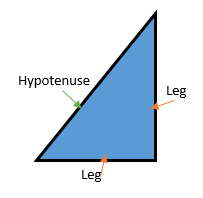
One of my favorite proofs for Pythagorean Theorem is pictorial. Pythagoras, the geometer, and his students discovered the pattern that sum of squares of the legs equals the square of the hypotenuse.  The legs are the sides of a right triangle; they are adjacent (next to) the right angle of the right triangle. The hypotenuse is the side of the right triangle opposite of the right angle (see figure 1).

Figure 1. Diagram of parts of right triangle.

Pythagorean Theorem is better known as a2+b2=c2. Now let me show you the pictorial proof. I’ll start with a large square with sides, a+b. Within the large square, there are four right triangles with sides a,b, and c where a and b are legs and c is the hypotenuse (see figure 2).


Figure 2. Square with right triangles.

Now I will calculate area of each of the shapes (see figure 3). The area of a triangle is one half base times height. The area of a square is one side squared.
 
Figure 3. Square with areas.

We know that the sum of the parts equal the area of the whole, so:

Therefore,
a2+b2=c2.

If you got math questions, e-mail at jdmathguy@gmail.com. Let's talk math.

Wednesday, August 26, 2015

Introduction to MathTalk with JD

Welcome to my blog, MathTalk with JD. I'm the JD in JDMathGuy. Maybe you found my YouTube channel, which is: http://www.youtube.com/user/jdmathguy . If you haven't, check it out.

A little about myself.
I graduated from college with my bachelor's in math education in 2006 and my master's in educational leadership with a specialization in mathematics in 2010. I tutored and taught various math subjects since 2004. I have been tutoring college students since that time as well. I have been teaching college students since 2011. I have experience as a tutor and an adjunct professor at various colleges. I'm currently a math professor and teach developmental mathematics, college algebra, and statistics. The place where I currently teach at, I have been there since 2012.

Purpose of this blog. The purpose of this blog is to explore different areas of mathematics and also answer your questions when it comes to mathematics. You can e-mail me your questions to jdmathguy@gmail.com.

So let's talk math!
-Professor JD